Unified AI-Powered Platform for Computational Biology
Neurosnap is a web-based bioinformatics platform that delivers advanced computational biology tools through a single, intuitive AI-driven web interface. From protein folding and molecular docking to RNA-seq analysis and in silico mutagenesis, Neurosnap removes the complexity of installing, maintaining, and scaling local bioinformatics software.
Designed for both academic and professional researchers, Neurosnap enables scientists to focus on discovery, not infrastructure.
Why Neurosnap?
Modern bioinformatics workflows often require high-performance computing, complex software installations, and deep programming expertise. Neurosnap changes this by providing a zero-code (or low-code) environment where advanced analyses can be executed directly in the browser.
Explore 100+ curated, validated bioinformatics tools.
Gain access to a trusted collection of 100+ published, state-of-the-art models and workflows with proven performance records.
Work entirely in your browser, no setup, no installs.
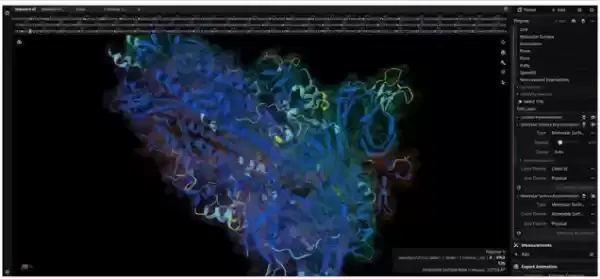
Perform folding, docking, and simulations seamlessly in our web workspace, analyze your results, fine-tune them easily, and share updates with your team instantly.
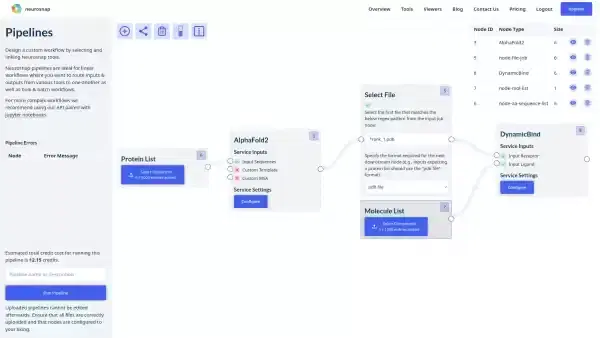
Design intelligent pipelines built around your workflow.
NeuroSnap Pipelines allow you to seamlessly connect tools, route outputs downstream, and automate decisions using custom logic.
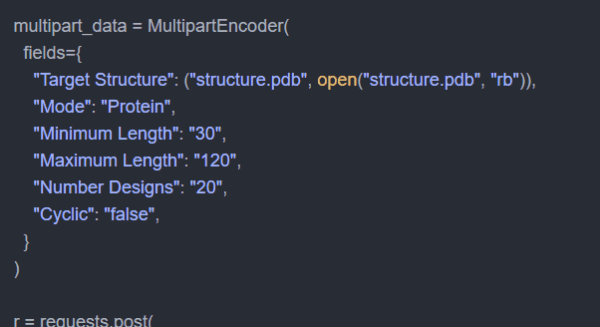
Let the API handle the heavy lifting.
Programmatically submit jobs, stream results, and integrate NeuroSnap into your existing pipelines. API examples are available for all tools.
With Neurosnap, researchers can:
Discover Powerful Features of Neurosnap for Smarter Scientific Decisions
NeuroSnap enables researchers to execute advanced computational biology workflows through an integrated, AI-powered platform. Each capability combines validated scientific methods with modern machine-learning models to accelerate discovery while maintaining analytical rigor.
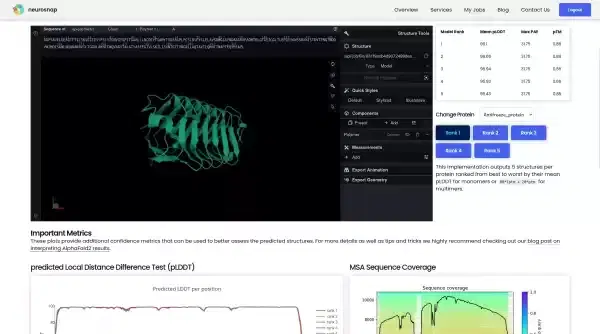
Protein Folding & Structure Prediction
Predict high-quality three-dimensional protein structures directly from amino acid sequences to support structural analysis, functional interpretation, and downstream modeling.
NeuroSnap integrates advanced structure prediction engines such as AlphaFold2, ESMFold, Boltz-1, AlphaFlow, and Chai-1, enabling users to select appropriate models based on sequence complexity, speed requirements, and research goals. Post-prediction structure refinement and validation workflows are supported through utilities like PDBFixer, ensuring clean, analysis-ready structural outputs.
Key outcomes
- Accurate protein structure generation
- Support for monomers and complex systems
- Ready-to-use models for docking, simulation, or publication
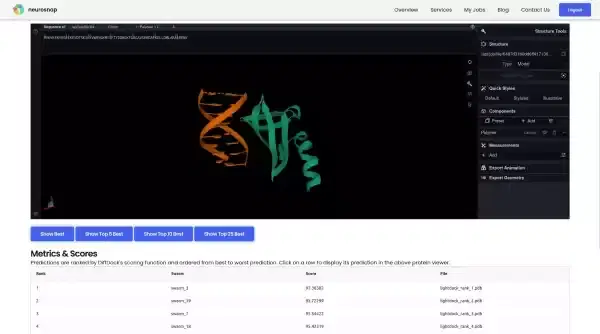
Molecular Docking & Drug Discovery
Evaluate molecular interactions to understand binding behavior between proteins and small molecules, supporting structure-based drug discovery and target validation.
NeuroSnap enables docking workflows using deep-learning–enhanced scoring engines such as GNINA, allowing more informed prediction of binding poses and affinities. These workflows can be combined with high-quality protein structures generated from folding pipelines to create end-to-end discovery workflows.
Applications
- Protein–ligand binding analysis
- Lead prioritization
- Structure-based hypothesis generation
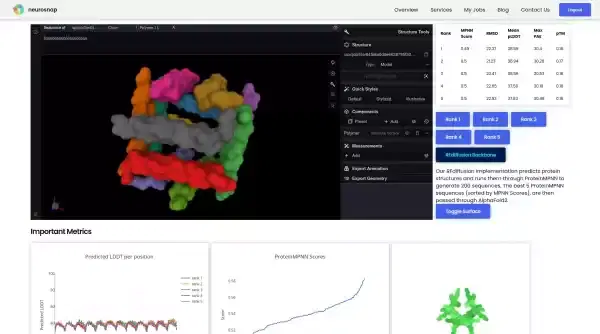
Protein Engineering & Mutagenesis
Explore protein sequence space computationally to design, optimize, and evaluate variants before experimental validation.
NeuroSnap supports AI-driven protein design and sequence optimization using generative and probabilistic models such as ProteinMPNN, Protein MPNN, ThermoMPNN, and RFdiffusion. These tools enable rational design of protein variants guided by predicted stability, structural compatibility, and functional constraints.
Applications
- In silico mutagenesis
- Stability and thermotolerance optimization
- Functional protein and enzyme design
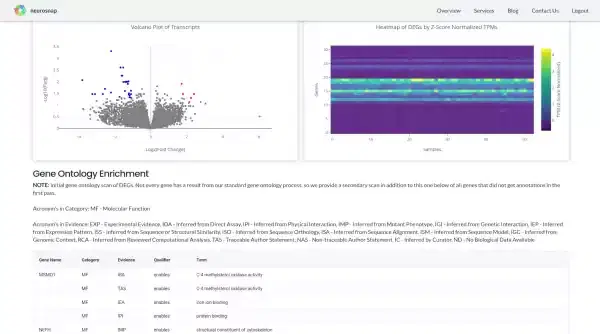
RNASeq & Transcriptomics
Analyze high-throughput transcriptomic data through structured, reproducible computational workflows designed for clarity and scalability.
NeuroSnap provides streamlined pipelines for transcript quantification, expression profiling, and comparative analysis, enabling researchers to derive meaningful biological insights from sequencing datasets without managing local computational infrastructure.
Applications
- Gene expression analysis
- Comparative transcriptomics
- Downloadable, publication-ready outputs
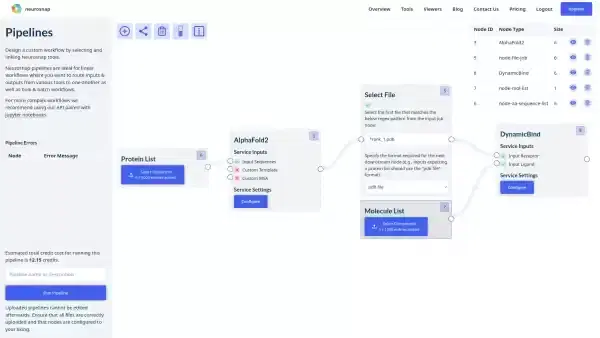
End-to-End Computational Pipelines
Execute complete computational biology workflows, from sequence input to predictive analysis, within a single, unified environment.
NeuroSnap enables chaining of AI-driven and physics-based tools into reproducible, version-controlled pipelines. A typical workflow may involve structure prediction (e.g., AlphaFold2, ESMFold, Boltz-1), structure refinement (PDBFixer), protein design (RFdiffusion, ProteinMPNN, ThermoMPNN), docking (GNINA), and downstream analysis. Pipelines can be executed via a user-friendly interface or automated at scale using API-based access.
How NeuroSnap Works?
NeuroSnap simplifies complex computational biology workflows by combining AI bioinformatics software, cloud infrastructure, and automated pipelines into a single, zero-code environment.
Select a Bioinformatics Service
Choose from a wide range of NeuroSnap bioinformatics services tailored for research and discovery workflows. The platform offers access to powerful computational biology tools, including a protein folding prediction tool, molecular docking online workflows, RNASeq analysis tools, and in-silico mutagenesis platforms.
Whether you are running an AlphaFold2 online tool for structure prediction or exploring drug discovery computational tools, NeuroSnap AI provides guided service selection without technical overhead.
Upload Input Data & Configure Settings
Upload your sequences, structures, or datasets directly into the NeuroSnap cloud bioinformatics platform. The zero-code bioinformatics platform enables users to configure analysis parameters through an intuitive interface, with no programming or local setup required.
Advanced users can fine-tune model selection and workflow options while maintaining full reproducibility across analyses.
Run the Job, We Handle the Heavy Compute
Once your job is submitted, NeuroSnap AI automatically manages the required compute resources. The cloud bioinformatics platform executes analyses using optimized hardware and bioinformatics automation tools, eliminating the need for GPUs, clusters, or local installations.
From protein folding prediction tools and molecular docking online workflows to large-scale RNASeq analysis tools, NeuroSnap handles computation in the background with reliability and scalability.
Visualize & Download Your Results
Monitor progress, visualize outputs, and access results directly within the NeuroSnap bioinformatics interface. Results can be downloaded for publication, reporting, or downstream analysis across multiple domains including drug discovery computational tools and computational biology tools.
NeuroSnap ensures outputs are structured, reproducible, and ready for further experimental or computational validation.
What Can You Do with Neurosnap
Protein Folding & Structure Prediction
Predict high-accuracy 3D protein and protein-complex structures directly from amino-acid sequences using state-of-the-art tools such as AlphaFold2 and Boltz-1 (AlphaFold3).
Protein Design & Engineering
Use NeuroFold, Neurosnap's proprietary enzyme-optimization engine, to design novel proteins or enhance existing enzymes for improved stability, activity, pH tolerance, and thermostability.
Molecular Docking & Drug / Ligand Design
Simulate molecular interactions including protein–protein, protein–ligand, and protein–nucleic acid docking, supporting early-stage drug discovery and candidate screening.
In Silico Mutagenesis & Variant Generation
Generate and evaluate large libraries of protein or enzyme variants computationally, enabling data-driven mutation selection before laboratory validation.
Molecular Dynamics (MD) Simulations
Run molecular dynamics simulations using established engines such as GROMACS to study protein motion, conformational changes, and binding stability, without local HPC infrastructure.
RNA-seq & Transcriptome Analysis
Process sequencing data from raw reads through quantification and differential expression analysis to support genomics and transcriptomics research.
Binder, Antibody & Peptide Design
Leverage NeuroBind to design antibodies, nanobodies, or peptides that bind to specific target sequences for therapeutic and diagnostic development.
No-Code Interface with API Access
Execute workflows through an intuitive graphical interface, or automate large-scale analyses using the Neurosnap API for seamless integration with existing pipelines.
Advanced Bioinformatics with Neurosnap AI ?
Web-First Accessibility
All tools run through the browser with no local installation, no dependency management, and no hardware constraints.
End-to-End Workflow Integration
Chain workflows within one platform: design → fold → dock → simulate → analyze.
Proprietary AI Models
NeuroFold offers AI-driven enzyme optimization and has demonstrated strong experimental success while preserving biological function.
Built for Biologists
Designed for users without deep computational backgrounds, while still offering API-based flexibility for advanced users.
Scalable & Cost-Effective
Subscription-based compute credits allow individuals and small labs to access powerful resources without capital investment.
Trusted, Secure, and Research-Focused
Neurosnap emphasizes data privacy and IP ownership, enabling researchers to work confidently with sensitive or proprietary datasets. Results are intended to accelerate hypothesis generation and experimental planning.
AI Models & Engines Powering NeuroSnap
Antibody Design
AI-powered antibody engineering workflows
NeuroSnap enables antibody discovery and optimization by modeling antigen–antibody interactions and multi-chain assemblies. These workflows support rational antibody design with a focus on binding specificity and developability.
Best used for
- CDR loop modeling and refinement
- Antigen-specific antibody design
- Affinity maturation and interaction analysis
Protein Annotation
Automated functional and domain-level interpretation
NeuroSnap annotates protein sequences and structures with functional domains, motifs, and biological context, enabling rapid interpretation without manual curation.
Best used for
- Domain and motif identification
- Structure–function insights
- Pathway and ontology mapping
Protein Clustering
Large-scale protein similarity analysis
NeuroSnap groups proteins based on sequence and structural similarity, enabling efficient dataset organization and comparative proteomics at scale.
Best used for
- Protein family classification
- Redundancy reduction
- Comparative protein analysis
Protein Localization
Subcellular targeting prediction
NeuroSnap predicts the most likely cellular location of proteins, providing biological context that informs experimental design and downstream validation.
Best used for
- Subcellular localization analysis
- Functional role interpretation
- Experimental planning
Signal Peptide Detection
Secretory pathway and targeting analysis
NeuroSnap identifies signal peptides and cleavage sites to determine whether proteins are secreted or membrane-associated.
Best used for
- Secreted protein discovery
- Membrane protein screening
- Expression system selection
Protein Solubility
Developability-focused solubility assessment
NeuroSnap evaluates solubility and aggregation risk to help prioritize protein variants with higher experimental success rates.
Best used for
- Expression feasibility screening
- Aggregation risk reduction
- Variant prioritization
Protein Expression
Host-aware expression optimization
NeuroSnap analyzes sequence features and codon usage to predict protein expression efficiency across common host systems.
Best used for
- Host-specific expression planning
- Codon optimization insights
- Production success prediction
Toxicity Prediction
Early-stage safety assessment
NeuroSnap screens proteins and peptides for potential toxicity and off-target effects, enabling safer design decisions earlier in the pipeline.
Best used for
- Therapeutic candidate screening
- Risk mitigation
- Lead prioritization
RNASeq
End-to-end RNA sequencing analysis
NeuroSnap processes raw RNASeq data into actionable gene expression insights using automated pipelines and AI-assisted interpretation.
Best used for
- Gene expression profiling
- Differential expression analysis
- Transcript discovery
Transcriptome Analysis
Systems-level gene regulation insights
NeuroSnap integrates RNASeq outputs to deliver a comprehensive view of transcript-level regulation, alternative splicing, and biological response patterns.
Best used for
- Pathway-level expression analysis
- Condition-based transcriptome comparison
- Biomarker discovery
AlphaFold2
High-accuracy protein structure prediction
AlphaFold2 predicts three-dimensional protein structures from amino acid sequences using deep learning trained on known structural data. It is widely trusted for high-confidence structure generation and serves as a foundational tool for structural biology and downstream computational analyses.
Best used for
- Benchmark-quality protein structures
- Structural interpretation and validation
- Input for docking and molecular simulations
ESMFold
Fast structure prediction using protein language models
ESMFold leverages large protein language models to quickly predict protein structures. It is optimized for speed and scalability, making it ideal for large datasets and rapid exploratory studies.
Best used for
- High-throughput structure prediction
- Rapid prototyping and screening
- Preliminary structural analysis
Boltz-1
Next-generation structure prediction for complex systems
Boltz-1 is designed to predict structures of complex biological assemblies, including protein complexes and challenging targets. It offers enhanced modeling capabilities for multi-chain and interaction-heavy systems.
Best used for
- Protein complexes
- Interaction-focused studies
- Advanced structural modeling
AlphaFlow
Flow-based protein structure modeling
AlphaFlow applies flow-matching principles to structure prediction, allowing efficient sampling of protein conformations. It complements traditional folding tools by offering alternative structural perspectives.
Best used for
- Structural diversity exploration
- Conformation sampling
- Comparative structure analysis
Chai-1
AI-assisted multi-chain and interaction modeling
Chai-1 focuses on modeling biomolecular interactions and assemblies, addressing challenges in predicting multi-chain and interdependent protein systems.
Best used for
- Multi-chain protein systems
- Interaction modeling
- Complex biological assemblies
ProteinMPNN
Structure-guided protein sequence design
ProteinMPNN designs amino acid sequences that are compatible with a given protein backbone. It enables rational protein design by optimizing sequences while preserving structural integrity.
Best used for
- Protein redesign
- Functional variant generation
- Backbone-constrained sequence optimization
ThermoMPNN
Stability-focused protein optimization
ThermoMPNN extends sequence design by prioritizing thermodynamic stability and robustness. It is particularly useful for improving protein performance under demanding conditions.
Best used for
- Thermostability optimization
- Industrial and enzyme applications
- Stability-driven variant screening
RFdiffusion
Generative protein structure design
RFdiffusion generates entirely new protein structures or scaffolds using diffusion-based generative modeling. It enables exploration beyond known protein families for innovative design applications.
Best used for
- De novo protein design
- Scaffold generation
- Binder and motif creation
GNINA
Deep learning–enhanced molecular docking
GNINA integrates convolutional neural networks into molecular docking workflows to improve pose prediction and scoring accuracy.
Best used for
- Protein–ligand docking
- Drug discovery and screening
- Binding affinity estimation
PDBFixer
Structure preparation and correction utility
PDBFixer cleans and repairs protein structures by fixing missing residues, atoms, and formatting issues, ensuring models are ready for docking, simulations, or further computational workflows.
Best used for
- Structure preprocessing
- Model cleanup and validation
- Simulation-ready preparation
FAQ's
Who Uses Neurosnap?
Neurosnap bioinformatics tools are ideal for:
- Academic researchers and students
- Labs without dedicated HPC resources
- Protein and enzyme engineering teams
- Drug discovery and molecular design projects
- Synthetic biology and transcriptomics research
Do I need programming skills?
No. NeuroSnap offers an intuitive, no-code interface while also providing API access for users who require automation and advanced workflows.
Is software installation required?
No installation is needed. All analyses run securely on the cloud and are accessible through a standard web browser.
How does AI enhance analysis?
AI models assist with biological predictions, variant prioritization, and workflow optimization, helping researchers accelerate insights while maintaining scientific rigor.
Can results be used for publications?
Yes. All outputs, including models and reports, can be downloaded and used for publications, presentations, or further analysis.
Is there a trial or entry-level plan?
Yes. NeuroSnap offers limited-access plans so users can explore key features before upgrading.
How can I get started?
You can request a demo or contact the NeuroSnap team for onboarding support and plan guidance.
How is AI used in NeuroSnap?
AI models are used to enhance biological predictions, assist in protein variant prioritization, optimize design workflows, and accelerate computational analysis. AI supports decision-making but does not replace experimental validation.
Are the predictions experimentally validated?
Computational predictions are based on well-established algorithms and modern AI models. However, results should be treated as in silico hypotheses and validated through laboratory experiments before downstream application.
Can beginners use the platform?
Yes. NeuroSnap provides intuitive interfaces, guided workflows, and documentation designed for users with minimal computational background, while still supporting advanced users through APIs and customization options.
What types of protein analysis are supported?
The platform supports:
- Protein structure prediction
- Protein engineering and variant analysis
- Binding and interaction studies
- Molecular docking
- Molecular dynamics simulations
Can I design or test protein variants in silico?
Yes. Users can generate variants computationally and evaluate them based on predicted structural stability, functional potential, and interaction behavior before experimental testing.
Does NeuroSnap support molecular docking?
Yes. The platform supports molecular docking workflows to study interactions such as protein–ligand, protein–protein, and protein–nucleic acid systems.
Does NeuroSnap support RNA-seq or genomics analysis?
Yes. NeuroSnap includes workflows for transcriptomic data analysis, including alignment, quantification, and differential expression analysis, enabling interpretation of high-throughput sequencing data.
Can I download results for publication?
Yes. All analysis outputs, models, and reports can be downloaded and used for publications, presentations, or further offline analysis.
Does NeuroSnap support automation?
Yes. In addition to the web interface, NeuroSnap provides API access that allows users to automate workflows, run batch analyses, and integrate the platform with existing pipelines.